In short
This unit price calculator finds the price of one unit, such as one ounce, one pound, one liter or one item. Divide the pack price by the amount in the pack. Put every pack in the same unit first.
The pack with the lower unit price costs less per unit. It is made for sellers who buy supplies in different pack sizes. Enter up to 4 packs to see the cheaper one and how much more the others cost.
- 2 lb tub35.0¢ per ozShea butter example
- 24 oz tub37.5¢ per oz
- Gap per ounce2.5¢ less
- On 32 oz$0.80 less
Inputs
How to enter each pack’s price and size
Entering a multipack or a “2 for” price
A multipack holds more than one item. Tell the tool how many items it holds and how big one item is. The tool finds the total amount.
1. Enter 6 in Items in the pack.
2. Enter 8 as the size of each item. Choose oz.
3. Enter $22.80 as the pack price. The total amount is 48 oz.
The multipack costs 47.5¢ per oz. One 8 oz jar at $4.25 costs 53.1¢ per oz. The multipack costs 5.6¢ less per oz, or $2.70 less for 48 oz.
A shop may sell 1 jar for $2.90 and 2 jars for $5.40. NIST says each selling price gets its own unit price. Enter each deal as its own row.
The single jar costs 36.3¢ per oz. The 2 jar deal costs 33.8¢ per oz. That is 2.5¢ less per oz, or $0.40 less for 16 oz.
The math
Unit price formula: price ÷ amount in one unit
Unit prices of $1 or more round to the nearest cent. Under $1, they round to the nearest tenth of a cent. A 5 or more rounds up. The cheapest pack is chosen from the exact numbers, before rounding. Check: multiply the unit price by the total amount. You get the pack price again (35.0¢ times 32 oz is $11.20). The unit price is what you pay. To set what you charge for each unit, see the product pricing calculator under Related.
The total amount is how much is in the whole pack, in one unit. 1. Multiply 1 item by 2 lb. 2. Multiply by 16 to change pounds to ounces. The total amount is 32 oz.
The unit price is what you pay for one unit. 1. Divide $11.20 by 32 oz. The unit price is 35.0¢ per oz.
This is how much more the other pack costs for each unit. 1. Take 35.0¢ away from 37.5¢. The 24 oz tub costs 2.5¢ more per oz.
This turns the gap into dollars. 1. Multiply 37.5¢ by 32 oz. At the 24 oz tub rate, 32 oz costs $12.00. 2. Take $11.20 away from $12.00. The extra is $0.80.
Price per pound to price per ounce
To change an amount, multiply. A 2 lb tub holds 2 times 16, which is 32 oz. To change a price per unit, divide. A price per pound divided by 16 is a price per ounce.
Use these amounts: 1 lb = 16 oz. 1 kg = 1,000 g, or about 2.205 lb. 1 oz is about 28.35 g. 1 gal = 4 qt = 128 fl oz. 1 qt = 2 pt = 32 fl oz. 1 L = 1,000 mL, or about 33.814 fl oz. 1 fl oz is about 29.57 mL.
| To change a price | Do this | Example |
|---|---|---|
| Price per lb to price per oz | Divide by 16 | $5.60 per lb is 35.0¢ per oz |
| Price per oz to price per lb | Multiply by 16 | 37.5¢ per oz is $6.00 per lb |
| Price per kg to price per 100 g | Divide by 10 | $12.35 per kg is $1.23 per 100 g |
| Price per gal to price per fl oz | Divide by 128 | $36.50 per gal is 28.5¢ per fl oz |
| Price per gal to price per qt | Divide by 4 | $36.50 per gal is $9.13 per qt |
| Price per L to price per 100 mL | Divide by 10 | $9.50 per L is 95.0¢ per 100 mL |
The examples use the starting packs here and the olive oil packs below.
Excel and Google Sheets
Unit price calculator spreadsheet formulas
Use column A for the name, B for the pack price and C for the items. Use D for the size of each in oz, E for the total oz and F for the price per oz. Put the 2 lb tub in row 2 and the 24 oz tub in row 3. These formulas have not been run in a spreadsheet app.
| Find | Formula | Example |
|---|---|---|
| Total oz | =C2*D2 | 32 oz |
| Total oz, size in lb | =C2*D2*16 | 1 × 2 lb × 16 = 32 oz |
| Price per oz in dollars | =B2/E2 | 0.35 |
| Price per oz in cents | =ROUND(F2*100, | 35.0 |
| Cheapest pack | =INDEX(A2:A5, | 2 lb tub |
Example
Unit price example: two tubs of shea butter
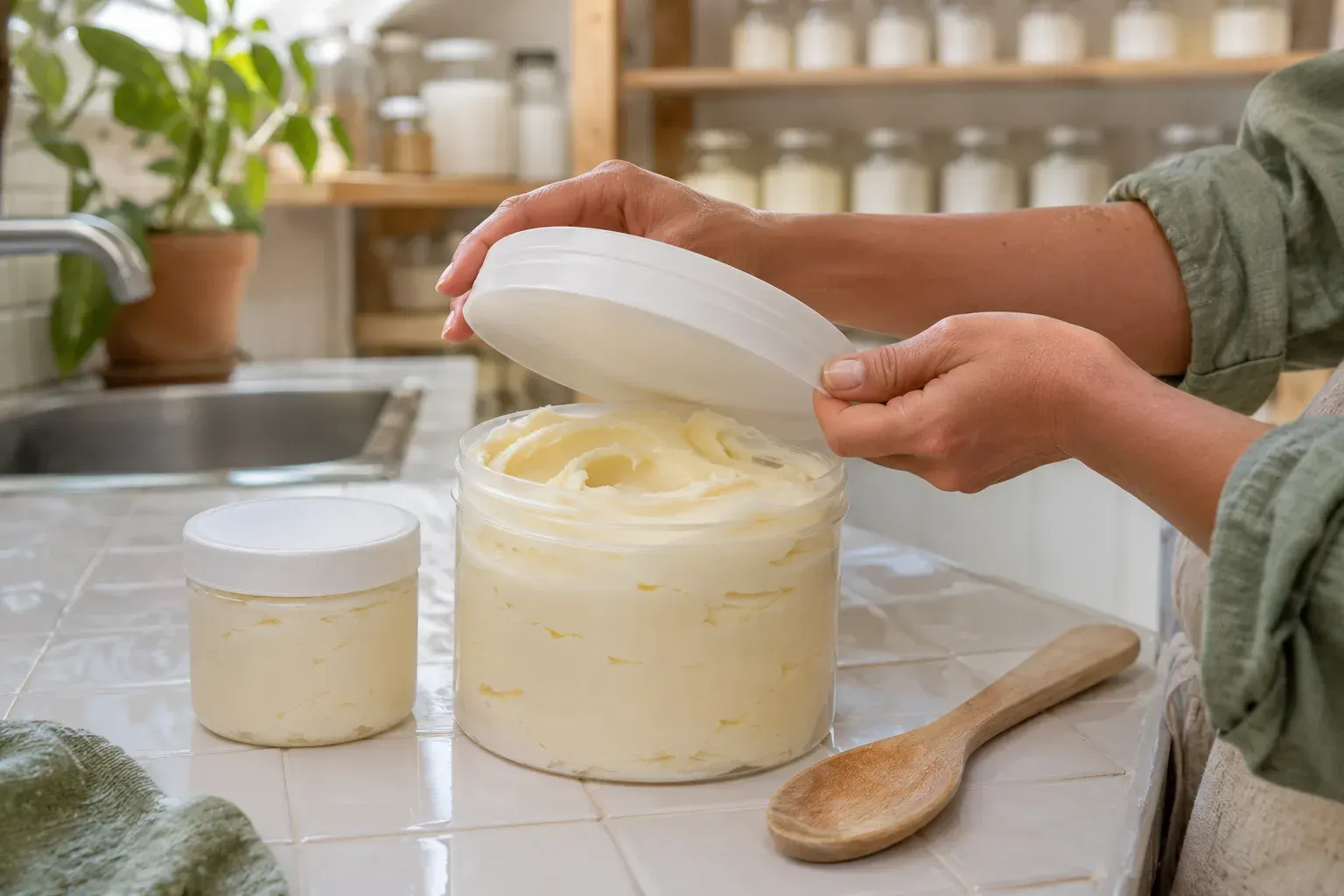
Example only: shea butter for soap making. One 2 lb tub costs $11.20. One 24 oz tub costs $9.00. Compare them per ounce.
The 2 lb tub costs 2.5¢ less per ounce, so its 32 oz cost $0.80 less than at the small tub’s rate. It costs $2.20 more up front.
More unit price examples: olive oil and mailers
| Pack | Amount in oz | Unit price (¢ per oz) |
|---|---|---|
| 2 lb tub | 32 oz | 35.0¢ |
| 24 oz tub | 24 oz | 37.5¢ |
The shorter bar is the cheaper pack.
A bigger pack is not always cheaper. A 1 gal jug of olive oil costs $36.50. A 1 L bottle costs $9.50. Per fl oz, the jug costs 28.5¢ and the bottle costs 28.1¢. The bottle costs 0.4¢ less per fl oz, or $0.14 less for 1 L.
| Compare per | 1 gal jug | 1 L bottle | Jug costs more by |
|---|---|---|---|
| fl oz | 28.5¢ | 28.1¢ | 0.4¢ |
| L | $9.64 | $9.50 | 14.2¢ |
| 100 mL | 96.4¢ | 95.0¢ | 1.4¢ |
| qt | $9.13 | $8.99 | 13.5¢ |
| gal | $36.50 | $35.96 | 53.9¢ |
The cheaper pack is the same in every row. Only the unit changes.
Mailers show the other case. A pack of 100 costs $17.50. A pack of 250 costs $39.50. Per mailer, that is 17.5¢ and 15.8¢. The pack of 250 costs 1.7¢ less per mailer. At the pack of 100 rate, 250 mailers would cost $4.25 more.
Per 100 mailers, the prices are $17.50 and $15.80. If you make products, use the cost per ounce of a supply in your materials cost. See the craft pricing calculator under Related.

Interpret
Reading your unit price result: which pack is cheaper
Lower means cheaper per unit
The pack with the lower unit price costs less for each unit. Here the 2 lb tub costs 35.0¢ per oz and the 24 oz tub costs 37.5¢ per oz.
The extra line turns the gap into dollars
A gap of 2.5¢ per oz is hard to feel. The tool prices the same amount at the other rate. That shows the difference as dollars: $0.80 for 32 oz.
A cheaper unit price can still be the wrong buy
The 2 lb tub costs $2.20 more today. If you will not use all of it, the smaller pack may suit you better. The tool cannot judge how much you will use.
Ties get one more decimal place
Two packs can show the same unit price after rounding. The tool then shows one more place for both, so you can see which is cheaper. The cheapest pack is always picked from the exact numbers.
How unit prices are rounded
NIST lets a store show a unit price under $1 in whole cents or in tenths of a cent. A store must pick one way and not use both. This tool shows tenths of a cent.
| Exact unit price | Shown here | Whole-cent option |
|---|---|---|
| 37.5¢ | 37.5¢ | 38¢ |
| 13.5¢ | 13.5¢ | 14¢ |
| 13.4¢ | 13.4¢ | 13¢ |
| 13.05¢ | 13.1¢ | 13¢ |
| 99.94¢ | 99.9¢ | $1.00 |
| 99.95¢ | $1.00 | $1.00 |
| 100.5¢ | $1.01 | $1.01 |
| 560¢ | $5.60 | $5.60 |
| 0.05¢ | 0.1¢ | 0¢ |
| 0.04¢ | under 0.1¢ | 0¢ |
NIST’s own examples are 13.5¢, which rounds up to 14¢, and 13.4¢, which rounds down to 13¢.
Avoid
Unit price mistakes with ounces, fluid ounces and multipacks
Comparing a price per pound with a price per ounce
Put every pack in the same unit before you compare. NIST says to choose one unit of measure and price the items consistently.
Wrong$5.60 per lb vs 37.5¢ per ozRight35.0¢ vs 37.5¢ per ozDividing by the number of jars
A multipack’s unit price divides by the total amount, not by the jar count. 6 jars of 8 oz hold 48 oz.
Wrong$3.80 per jarRight47.5¢ per ozTreating a fluid ounce as an ounce
An ounce (oz) measures weight. A fluid ounce (fl oz) measures liquid volume. They are different kinds of unit, so the tool will not compare them.
Wrong16 fl oz = 16 ozRightWeight and volume are different unitsRounding too early
Rounding can hide a small gap. A 23 oz bag at $7.99 and a 32 oz bag at $11.11 both show 34.7¢ per oz. The exact numbers differ.
Wrong34.7¢ = 34.7¢Right34.74¢ vs 34.72¢
Limits
What the unit price calculator leaves out
- This tool compares packs by the prices and sizes you enter, in US dollars. It does not look at the quality of a product or how much you will use.
- Shipping, freight and duty stay out. Use the landed cost calculator under Related for the cost per unit with those costs added.
- Sales tax and coupons stay out. Use the discount calculator under Related for a sale price.
- State shelf-label rules stay out. This is not a compliance check.
- Use 1 to 4 filled rows. A row counts when it has a price and a size. A name alone does not count.
- Pack prices run from $0.01 to $1 billion, with two decimal places. Items run from 1 to 10,000, in whole numbers.
- Sizes run from 0.001 to 100,000, with up to 3 decimal places. Names allow 40 characters.
- All packs must be weight, or all liquid volume, or all count. Weight and volume cannot be compared without the product’s density, so the tool does not convert between them.
- The tool uses the US fluid ounce. A UK fluid ounce is a different size, so enter a UK bottle in mL.
- Length and area units, dry pints and dry quarts stay out.
- Nothing you enter is saved or sent.
Showing a unit price on your store
Shopify has a unit price setting that uses the same math: the price divided by the units in the product. It is optional for every product. Each product or variant can hold one unit price.
Shopify also says that showing a price per unit is a legal requirement in some regions. It tells you to find out if your business is subject to it.
- Is unit pricing required?No federal rule requires it. Some states have their own rules, so ask your state’s weights and measures office. NIST’s model rule applies only when a store chooses to show unit prices. This tool is not a compliance check.
Questions
Questions
Is a unit price the same as a unit rate?
A unit price is a unit rate for money. It gives the price of one unit, such as one ounce or one item. Read OpenStax on unit rates
Is the bigger pack always cheaper per unit?
No. The olive oil example above shows a smaller bottle with a lower unit price than a bigger jug. Check the unit price each time.
Should I compare by weight or by volume?
Use the unit on the label: weight for items sold by weight, volume for liquids and count for items. The tool will not mix weight and volume, because that needs the product’s density.
Can I use a price per serving or per load?
NIST does not count loads, uses or servings as units of measure. Use weight, volume or count for the unit price. Read NIST SP 1181 on units
Why does a shelf tag show a different unit price from mine?
The tag may use another unit, such as per pound instead of per ounce. It may also use the other NIST rounding option: whole cents under $1 instead of tenths of a cent. Read NIST Handbook 130 on unit pricing
My supplier’s pack got smaller at the same price. What now?
Enter the old and new packs as two rows. A 24 oz tub at $9.00 costs 37.5¢ per oz. A 21 oz tub at the same price costs 42.9¢ per oz. That is 5.4¢ more per oz, or $1.29 more for 24 oz.
Sources
Sources and review
Sources6 official pages, each read on the date shownShow allHide
- NIST SP 1181 (2025), Unit Pricing Guidenvlpubs.nist.gov · Read
What a unit price is, one unit of measure, rounding, multiple prices, loads and servings, and no federal mandate.
- NIST Handbook 130 (2026), Uniform Unit Pricing Regulationnist.gov · Read
Units by type, rounding under and over $1, consistent units, and a model rule that applies only when stores choose to show unit prices.
- NIST Handbook 44 (2026), Appendix Cnist.gov · Read
Exact unit factors, and the difference between an ounce and a fluid ounce.
- OpenStax Prealgebra 2e, 5.6 Ratios and rateopenstax.org · Read
The unit price formula, the lower unit price as the better buy, and one more decimal place for close prices.
- OpenStax Prealgebra 2e, 7.5 Systems of measurementopenstax.org · Read
Ounces in a pound and fluid ounces in a gallon.
- Shopify Help Center: Unit pricinghelp.shopify.com · Read
The optional unit price setting, one unit price for each variant, and the note that some regions require it.
The page text was last updated on November 2, 2026 and the sources were last checked on November 2, 2026. Example figures are illustrative and were made with the same formulas as the calculator.
Found a mistake or something unclear? Tell us. See how we check our pages.