In short
This bundle pricing calculator adds each item’s regular price and takes off your discount. A bundle groups related items at one price. Profit is the bundle price less your costs. Margin is the share of that price you keep as profit.
Compare the bundle with separate sales and with the main item alone. Add stock to count complete sets and see which item runs out first.
- Bundle price$39.10Tea gift set example
- Profit per bundle$23.30
- Vs the tea tin alone+$9.90
- Sets from your stock19 sets
Inputs
How to enter your bundle items and costs

Before you start
Which bundle costs should you count?
Count these
2- Each itemYesUse what you paid, or your materials and time if you make it.
- Extra bundle packagingYesCount a box, tissue, insert or label used only for the set.
Leave out
1- Your time to pack setsIt dependsAdd its cost if you want to count that time. Count it once.
Leave out
1- Fees, shipping and sales taxNoCheck these costs with the order and fee tools under Related.
The math
Bundle pricing formula: price, profit and margin
The discount rounds to the nearest cent. A price from a target margin rounds up to the next cent, so your margin is never below the number you typed. Shown percents round half up to two decimal places. The deepest discount percent from a target margin is cut down to two decimal places. This keeps the target safe if you use that percent. Check: add cost $15.80 and profit $23.30 to get $39.10 again. Margin divides by price; markup divides by cost. See the margin vs markup guide under Related.
The separate total is what a buyer pays for all the items one by one. 1. Add $21.00, $14.00, $11.00. The separate total is $46.00.
The discount is what the buyer saves. 15.00% means 15 cents off each $1.00. 1. Multiply $46.00 by 15.00%. The discount is $6.90.
The bundle price is what the buyer pays for the set. 1. Take $6.90 from $46.00. The bundle price is $39.10.
Bundle cost covers the items and any cost added only for the set. 1. Add $7.60, $4.40, $3.80 and extra cost $0.00. Bundle cost is $15.80.
Profit is what stays after bundle cost. 1. Take $15.80 from $39.10. Profit is $23.30.
Margin measures profit as a share of the bundle price. 1. Divide profit $23.30 by bundle price $39.10. As a percent, the margin is 59.59%.
Target margin finds the lowest price that keeps the share you choose. 1. Take 50.00% from 100%. The cost share is 50.00%. 2. Divide bundle cost $15.80 by that share. The price is $31.60.
Separate profit leaves out extra bundle cost. 1. Take item cost $15.80 from $46.00. Separate profit is $30.20. 2. Take $30.20 from $23.30. The bundle earns −$6.90 vs separate sales.
The main item is the first filled row, with its full quantity. 1. Take $7.60 from $21.00. Main item profit is $13.40. 2. Take $13.40 from $23.30. The bundle earns +$9.90 more.
This price gives the same profit as the main item alone. 1. Add bundle cost $15.80 to main item profit $13.40. The price is $29.20.
Excel and Google Sheets
Bundle pricing calculator spreadsheet formulas
Use columns A for name, B for price, C for cost, D for quantity and E for stock. Put the tea set in rows 2 to 4. Set F1 to 0.15, F2 to 0 and F3 to 0.5. Name your total cell total and your cost cell cost. These formulas have not been run in a spreadsheet app. A sheet can differ by a cent from this tool.
| Find | Formula | Example |
|---|---|---|
| Separate total | =SUMPRODUCT(B2:B4, | $46.00 |
| Bundle cost | =SUMPRODUCT(C2:C4, | $15.80 |
| Price, percent off | =total-ROUND(total*F1, | $39.10 |
| Price, target margin | =ROUNDUP(cost/(1-F3), | $31.60 |
| Sets from stock | =MIN(INT(E2:E4/D2:D4)) | 19 |
Example
Tea gift set bundle example
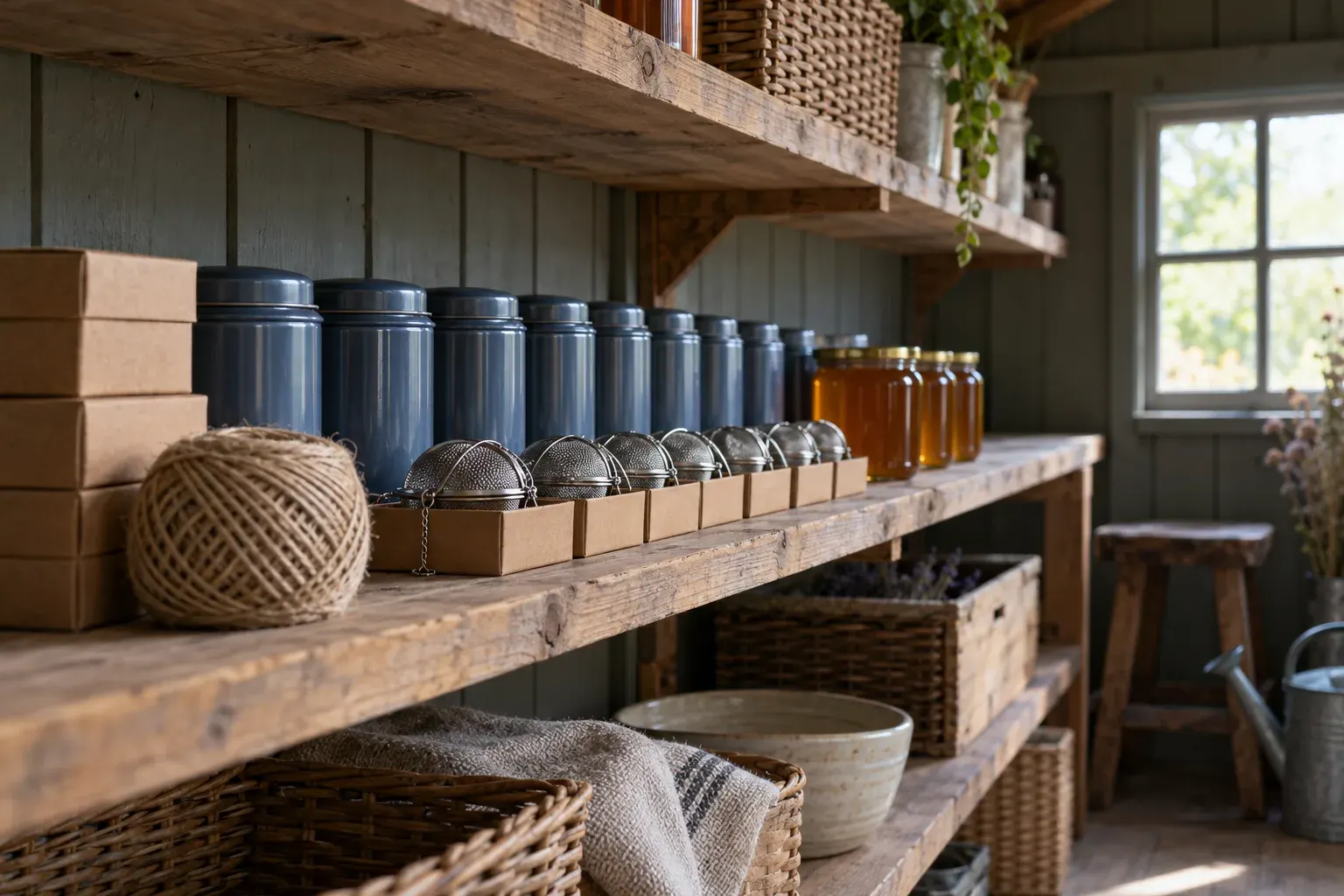
Example only: one tea tin, one infuser and one honey jar, with 15.00% off the total of all three. No extra cost.
The bundle earns $6.90 less than three separate sales and $9.90 more than the tea tin alone.
More bundle discounts on the tea set
- Cost
- $15.80
- Profit
- $30.20
- Cost
- $15.80
- Profit
- $23.30
- Cost
- $7.60
- Profit
- $13.40
The bundle shares the item costs with separate sales. Only the bundle has any extra bundle cost.
| Percent off | Bundle price | Profit | Margin | Vs separately | Vs tea tin alone |
|---|---|---|---|---|---|
| 0.00% | $46.00 | $30.20 | 65.65% | $0.00 | +$16.80 |
| 10.00% | $41.40 | $25.60 | 61.84% | −$4.60 | +$12.20 |
| 15.00% | $39.10 | $23.30 | 59.59% | −$6.90 | +$9.90 |
| 25.00% | $34.50 | $18.70 | 54.20% | −$11.50 | +$5.30 |
| 35.00% | $29.90 | $14.10 | 47.16% | −$16.10 | +$0.70 |
| 40.00% | $27.60 | $11.80 | 42.75% | −$18.40 | −$1.60 |
These are examples to compare, not suggested discounts.
With a $1.25 gift box, bundle cost is $17.05. Profit falls to $22.05 at 56.39% margin. That is −$8.15 vs separate sales and +$8.65 vs the tea tin alone.
How many bundles can you make from your stock?
The item with the fewest complete sets limits the bundle count. This is an estimate: count what you can still sell.
1. Divide the 26 tea tins by 1 per set. Tea tins allow 26 sets.
2. Divide the 31 infusers by 1 per set. Infusers allow 31 sets.
3. Divide the 19 honey jars by 1 per set. Honey jars allow 19 sets.
4. Take the lowest whole count. You can make 19 sets.
| Item | Stock | Per set | Sets possible | Left over |
|---|---|---|---|---|
| Tea tin | 26 | 1 | 26 | 7 |
| Infuser | 31 | 1 | 31 | 12 |
| Honey jar (runs out first) | 19 | 1 | 19 | 0 |
If all 19 sets sell, profit is $442.70 on sales of $742.90. This is not a sales forecast.
With 2 tea tins per set, you can make 13 sets. The tea tin runs out first. Left over: Tea tin 0, Infuser 18, Honey jar 6.
Rows with no stock are not counted. If any counted row has no complete set, the count is 0. Check the Shopify stock source below for the method.
Interpret
Is the bundle worth it? Bundle vs separate vs main item
Separate sales show the cost of the deal
The discount lowers dollar profit by $6.90. Extra bundle cost lowers it further. The item costs stay the same.
The main item shows what the add-ons earn
The infuser and honey jar add $16.80 profit at full price. The bundle discount uses part of that. This comparison helps if the buyer would buy only the tea tin anyway. It does not predict what they will buy.
A loss means the price is below cost
A negative profit or margin means the bundle does not pay the costs you entered. A zero profit covers only those costs. Fees and shipping can still lower what you keep.
Stock counts sets you could make
The count assumes every set uses the quantities you entered. It does not track other bundles or orders that use the same items.
How much should you discount a bundle?
The sources here give no set discount for all bundles. Use your own costs and the profit you want.
At a 50.00% target margin, this set needs a $31.60 price. The deepest discount is $14.40 (31.30%). Use Target margin to check your own set.
To match the tea tin's profit alone, keep the bundle price at $29.20. That allows $16.80 off (36.52%). A lower price earns less than the tea tin alone.
Avoid
Bundle pricing mistakes that cost profit
Treating percent off as margin points
15.00% off does not take 15 points off the margin. The bundle price changes too, so use profit divided by that price.
Wrong50.65%Right59.59%Leaving out the gift box
A $1.25 box cuts profit to $22.05 per set. On 19 sets, that cost adds up to $23.75.
Wrong$23.30Right$22.05Counting stock instead of complete sets
You have 26 tins but only 19 honey jars. Each set needs a jar. You can make 19 sets.
Wrong26 setsRight19 sets
Limits
Fees, shipping and platform bundle rules left out
- This tool prices one bundle in US dollars from your own prices and costs. It does not measure demand.
- Marketplace and payment fees, shipping, sales tax and returns stay out. Use the Etsy, eBay and Profit per order tools under Related.
- Tiered discounts, free-item offers and price per unit stay out. The platform notes below are context, not rules built into this tool.
- Use 1 to 5 filled rows and at least 2 units in total. Quantity must be a whole number from 1 to 100.
- Price each item from $0.01 to $1 billion. Item cost and extra bundle cost allow $0 to $1 billion.
- Separate total, bundle cost and bundle price must each be at most $1 billion. Money allows two decimal places.
- Percent off and target margin allow 0% to 99.99%, with two decimal places. Dollars off must be below the separate total.
- The bundle price must stay above $0. Target margin needs a cost above $0. A target price can exceed the separate total.
- Names allow 40 characters. Stock is optional, from 0 to 1,000,000 whole units. Large totals for all sets show over $1 billion.
- Stock totals use integer cents. Stock counts round down to complete sets. Displayed percents use the rounding rules above.
- This is an estimate, not legal or tax advice. Nothing you enter is saved or sent.
Shopify, Etsy and eBay bundle rules
- ShopifyThe item with the fewest complete sets limits stock. A bundle discount is split by each item’s share of the price.
- EtsyA discounted bundle can have up to 3 listings. Buyers must buy them all. A listing can be in one discounted bundle at a time. These discounts do not stack with other sales or deals.
- eBayFor 2, 3 or 4+ items, discounts have a $100 cap per order; partial returns trigger a new price on items kept.
Questions
Questions
What happens if a buyer returns one bundle item?
Refunds need a separate check against your return terms and the platform rules. This tool leaves returns out. Check eBay’s bundle return rule
Can one item be in two bundles at once?
Do not promise the same stock twice. If both sets use the same honey jars, split that stock before you count each set. Etsy also limits a listing to one discounted bundle at a time. Check Etsy’s discounted bundle rules
Does my Shopify bundle price change when an item price changes?
No. Shopify says to update the bundle price yourself when an item price changes. Recheck your price and costs here too. Read Shopify’s bundle price rules
Can I say “save $X” on a bundle?
Use real regular prices for the comparison. A brief rise to $25.00 for the tin would make the separate total $50.00. It would claim $10.90 saved at the same $39.10 bundle price. The saving from the regular prices is $6.90. The FTC guide warns against inflated former prices. Check the rules for your offer. Read the FTC former-price guide
Should I bundle a slow seller with a best seller?
Check profit against the main item alone first. A buyer may add an item they would skip on its own. The tool cannot tell you whether that will happen. Read OpenStax on bundle pricing
What are the downsides of bundle pricing?
A discount cuts profit compared with separate sales. Shared stock can limit the sets you can offer. A partial return also needs its own check.
Can I price a multipack of one item?
Yes. Fill one row and set the quantity to 3, for example. The same price and cost apply to each unit in that row.
Sources
Sources and review
Sources8 official pages, each read on the date shownShow allHide
- OpenStax Introduction to Business 2e, 11.9openstax.org · Read
What a bundle is and why a buyer might add a second item.
- OpenStax Contemporary Mathematics, 6.2openstax.org · Read
Discount and sale price formulas, paraphrased here.
- Shopify Help: Bundle eligibility and considerationshelp.shopify.com · Read
Fixed bundles, multipacks and complete sets from tracked stock.
- Shopify Help: Shopify Bundleshelp.shopify.com · Read
Manual bundle price updates and how a discount is split across items.
- Etsy Help: Sales and discountshelp.etsy.com · Read
Listing count, buying the full bundle, one bundle per listing and no discount stacking.
- eBay Help: Bundle discounts for sellersebay.com · Read
The per-order cap and price changes on a partial return.
- FTC: 16 CFR 233.1, Former price comparisonsecfr.gov · Read
Genuine regular prices as the basis for a savings claim.
The page text was last updated on October 26, 2026 and the sources were last checked on October 26, 2026. Example figures are illustrative and were made with the same formulas as the calculator.
Found a mistake or something unclear? Tell us. See how we check our pages.